


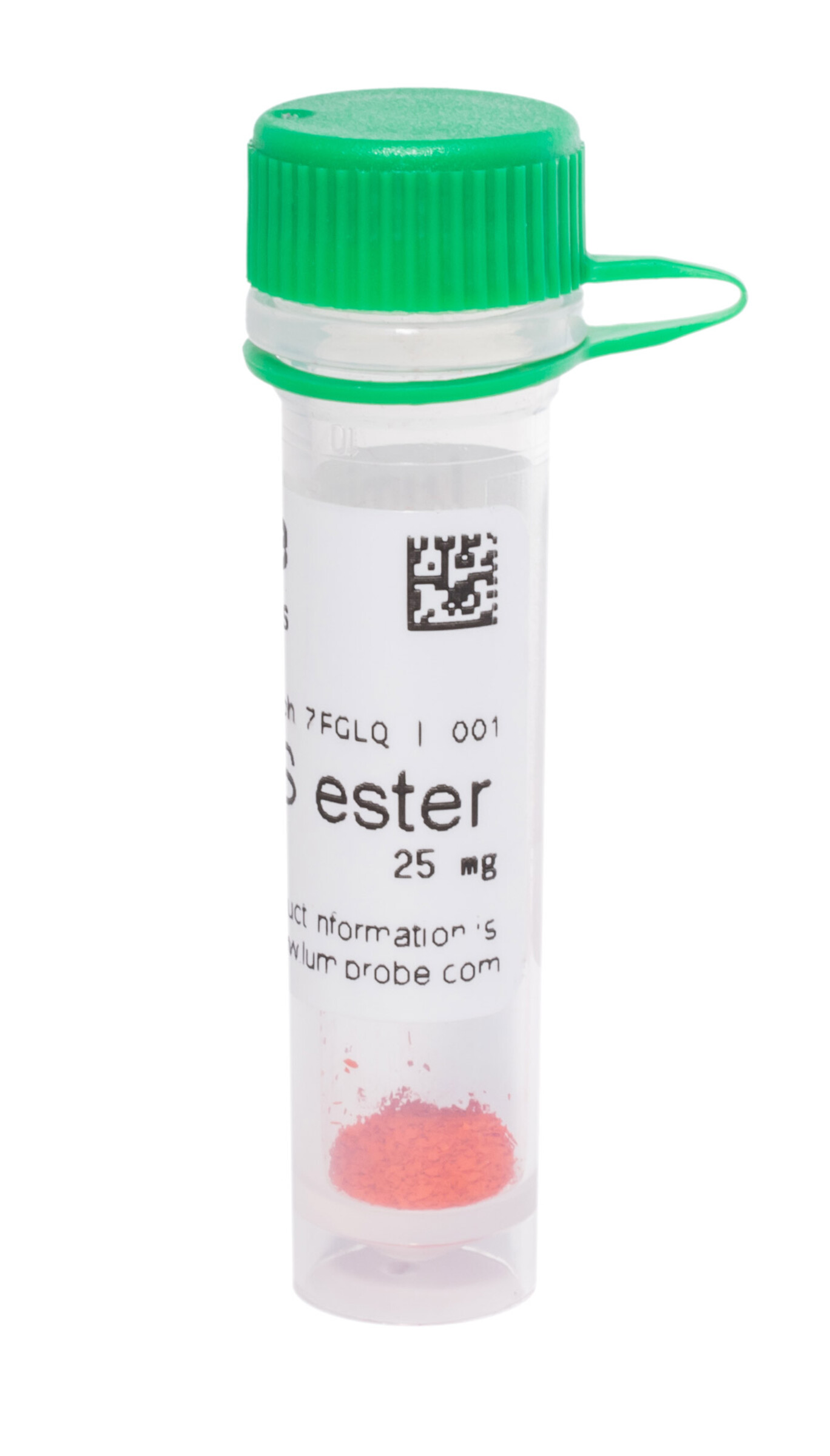
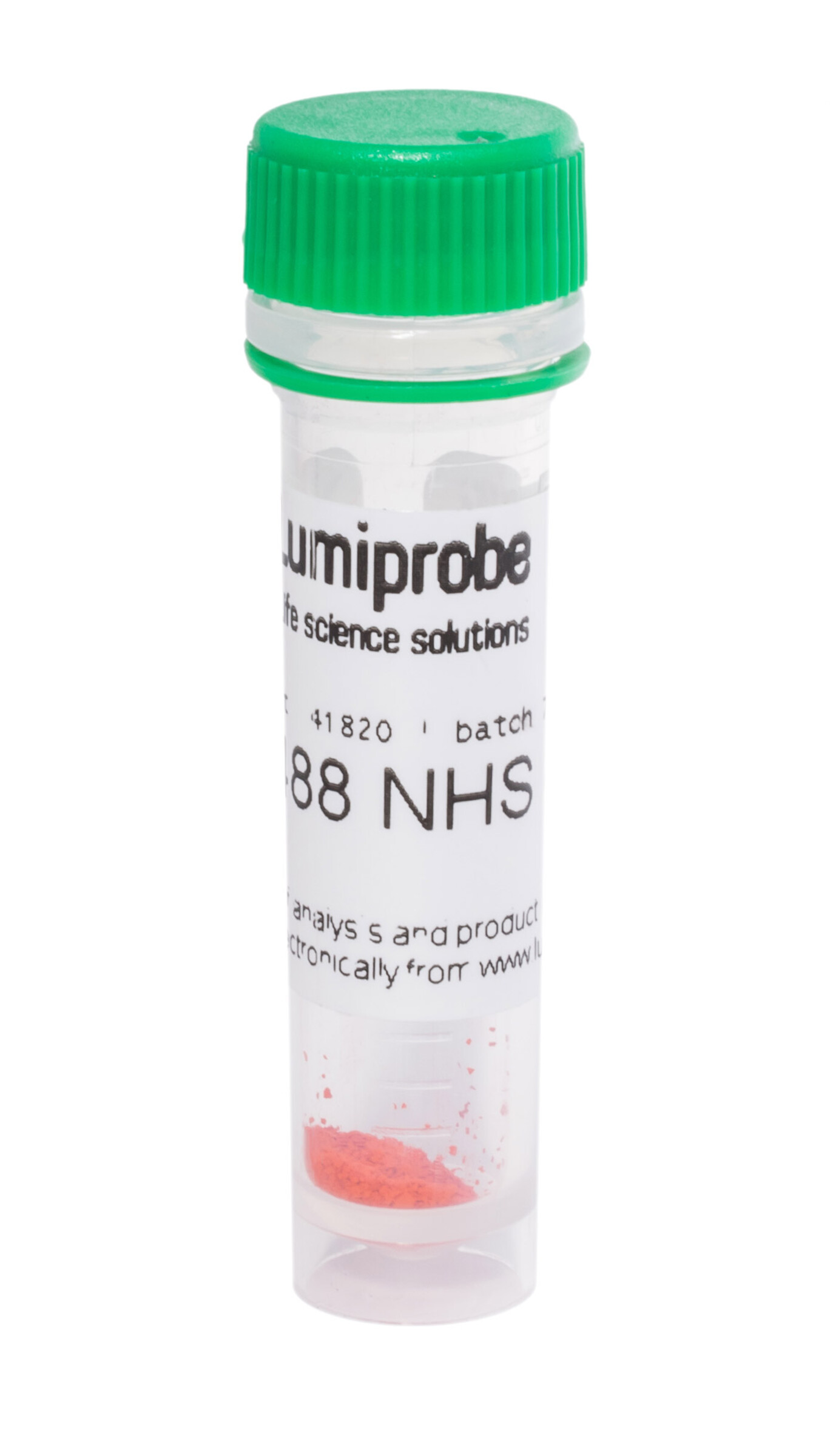
AF 488 NHS ester
| Cat. # | Quantity | Price | Lead time | Buy this product |
|---|---|---|---|---|
| 11820 | 1 mg |
$109.99
|
in stock | |
| 21820 | 5 mg |
$419.90

|
in stock | |
| 31820 | 10 mg |
$549.90
|
in stock | |
| 41820 | 25 mg |
$1299.00
|
in stock | |
| 51820 | 50 mg |
$1699.00
|
in stock | |
| 61820 | 100 mg |
$2299.00
|
in stock |


AF 488 is a bright and photostable dye. Due to its high hydrophilicity, this is a dye of choice for the labeling of sensitive proteins and antibodies. The dye is useful for many demanding applications, including microscopy.
AF 488 is a sulfonated rhodamine dye Rhodamine 110 (R110). Like other rhodamines, it is available as 5- and 6-isomers, which have almost identical photophysical properties. The isomers need to be separated, otherwise, the use of mixed isomer dye can lead to doubled peaks during HPLC or electrophoresis separations of the labeled products. This product is an isomerically pure 5-AF 488.
This NHS ester is an amine-reactive dye; it can label amine groups in proteins, peptides, amino-modified oligos, and other target molecules.


Absorption and emission spectra of AF 488

Customers also purchased with this product

Fluorescein (FAM) maleimide is a thiol reactive dye derived from isomerically pure 6-FAM. …

TAMRA-2,4-dinitroaniline is a probe for visualizing RNA in living cells.…


Water-soluble cycloalkyne for copper-free click chemistry reaction with azides. A derivati…
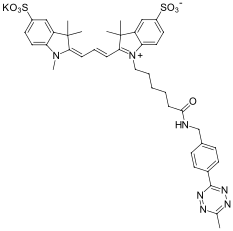
Water-soluble sulfo-Cyanine3 dye tetrazine derivative for TCO ligation labeling with trans…

Cy7 amine is a near infrared dye with free amine group for the conjugation with activated …

FAM (fluorescein) azide, 6-isomer is a commonly used fluorescent dye azide for сlick сhemi…

Cyclooctyne derivative of tetramethylrhodamine (TMR, TAMRA) for copper-free click chemistr…
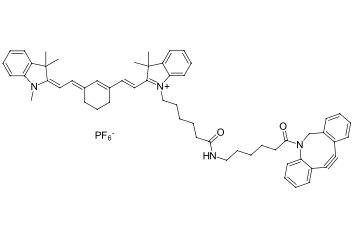
NIR fluorescent dye functionalized with cyclooctyne moiety for copper free click chemistry…

Azide derivative of TAMRA fluorescent dye for сlick chemistry.…
Azide of green-yellow emitting HEX dye for conjugation with oligonucleotides via [3+2]-dip…

Activated NHS ester of ROX (rhodamine X or rhodamine 101), pure 5-isomer, for the labeling…
General properties
| Appearance: | dark orange solid |
| Molecular weight: | 732.74 |
| Molecular formula: | C31H32N4O13S2 |
| Solubility: | good in water, DMF, DMSO |
| Quality control: | NMR 1H, HPLC-MS (80+%, balance mostly carboxylic acid) |
| Storage conditions: | Storage: 12 months after receipt at -20°C in the dark. Transportation: at room temperature for up to 3 weeks. Avoid prolonged exposure to light. Desiccate. |
| MSDS: | Download |
| Product specifications |
Spectral properties
| Excitation/absorption maximum, nm: | 495 |
| ε, L⋅mol−1⋅cm−1: | 71800 |
| Emission maximum, nm: | 519 |
| Fluorescence quantum yield: | 0.91 |
| CF260: | 0.16 |
| CF280: | 0.10 |
Product citations
- Marongiu, G. L.; Fink, U.; Schöpf, F.; Oder, A.; von Kries, J. P.; Roderer, D. Structural Basis for Immune Cell Binding of Fusobacterium Nucleatum via the Trimeric Autotransporter Adhesin CbpF. Proceedings of the National Academy of Sciences, 2025, 122(15), e2418155122. doi: 10.1073/pnas.2418155122
- Jimenez-Lopez, C.; Lopez-Blanco, R.; Esperon-Abril, I.; Fernandez-Megia, E. From Nano to Micro Polyion Complex Vesicles: Synthetic Cells with Membrane-Embedded Enzymes. ACS Appl. Mater. Interfaces, 2025, 17(33), 47426–47435. doi: 10.1021/acsami.5c11988
- Morath, V.; Fritschle, K.; Warmuth, L.; Anneser, M.; Dötsch, S.; Živanić, M.; Krumwiede, L.; Bösl, P.; Bozoglu, T.; Robu, S.; Libertini, S.; Kossatz, S.; Kupatt, C.; Schwaiger, M.; Steiger, K.; Busch, D. H.; Skerra, A.; Weber, W. A. PET-Based Tracking of CAR T Cells and Viral Gene Transfer Using a Cell Surface Reporter That Binds to Lanthanide Complexes. Nat. Biomed. Eng, 2025, 1–21. doi: 10.1038/s41551-025-01415-7
- Armstrong, M. C.; Weiß, Y. R.; Hoachlander-Hobby, L. E.; Roy, A. A.; Visco, I.; Moe, A.; Golding, A. E.; Hansen, S. D.; Bement, W. M.; Bieling, P. The Biochemical Mechanism of Rho GTPase Membrane Binding, Activation and Retention in Activity Patterning. EMBO J, 2025, 44(9), 2620–2657. doi: 10.1038/s44318-025-00418-z
This Product is offered and sold for research purposes only. It has not been tested for safety and efficacy in food, drug, medical device, cosmetic, commercial or any other use. Supply does not express or imply authorization to use for any other purpose, including, without limitation, in vitro diagnostic purposes, in the manufacture of food or pharmaceutical products, in medical devices or in cosmetic products.

Short link - lumiprobe.com/sh/p/5W

The count of items is incorrect.

 Your cart is empty

 $
$