


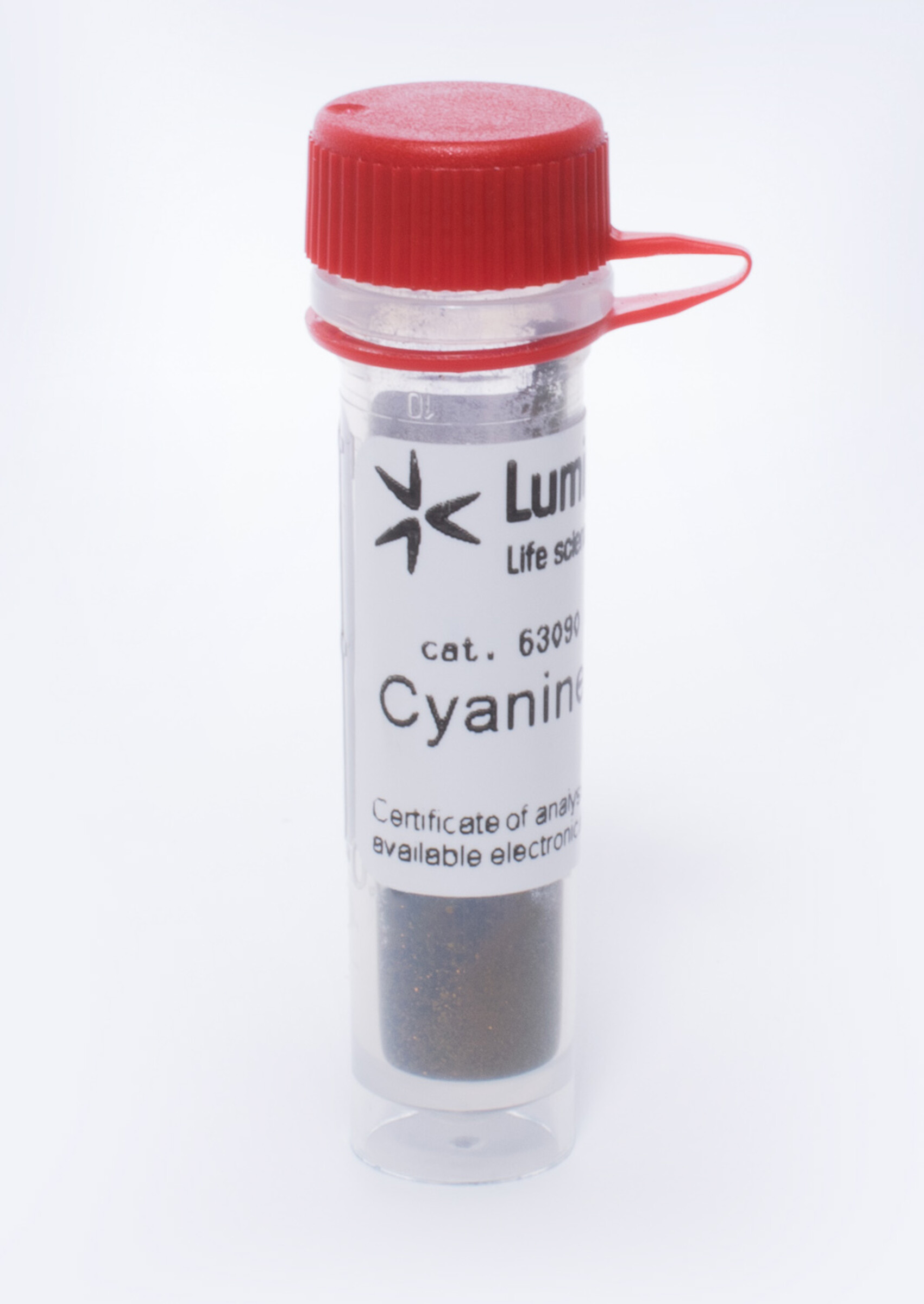
Cyanine5 carboxylic acid
| Cat. # | Quantity | Price | Lead time | Buy this product |
|---|---|---|---|---|
| 13090 | 1 mg |
$110.00
|
in stock | |
| 23090 | 5 mg |
$210.00
|
in stock | |
| 43090 | 25 mg |
$449.90

|
in stock | |
| 53090 | 50 mg |
$769.90
|
in stock | |
| 63090 | 100 mg |
$1190.00
|
in stock |


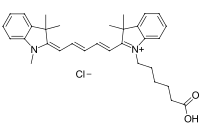
Non-activated carboxylic acid, an analog of Cy5® free carboxylic acid. Contains Cyanine5 fluorophore.
This dye has limited water solubility, but can be dissolved in mixtures of water with organic phase (DMF, DMSO, alcohols) to obtain useful concentrations of the material in solution. Water-soluble version is available.
This molecule can be considered non-reactive dye for the use in control samples, and for instrument calibration. For coupling with amines and protein labeling, consider using Cyanine5 NHS ester, or water-soluble sulfo-Cyanine5 NHS ester.


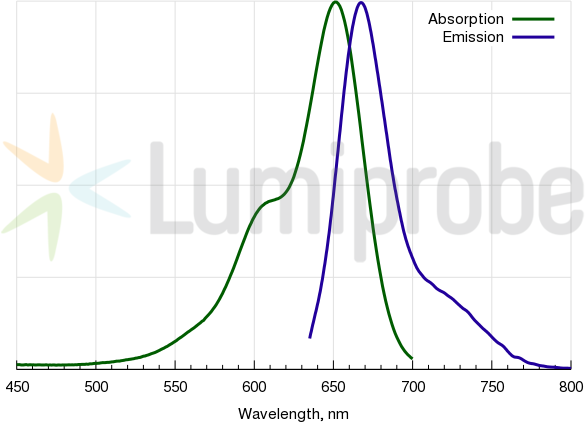
Cyanine5 absorbance and emission spectra
Customers also purchased with this product

sulfo-Cyanine3 free unactivated monofunctional carboxylic acid, water-soluble dye.…

Sulfonated Cyanine5 amine derivative for the conjugation with electrophiles and enzymatic …

sulfo-Cyanine7 NHS ester is a water-soluble, near-infrared, amine-reactive dye.…

A tyramide derivative of sulfo-Cyanine3, an orange fluorescent reagent widely used for tyr…

Amine-reactive, activated N-hydroxysuccinimidyl ester of TAMRA dye for the labeling of ami…

THPTA is a water-soluble ligand for Cu(I)-catalyzed click chemistry. The ligand stabilizes…

Water soluble cyanine dye with bright fluorescence and high extinction coefficient. Contai…

A bright, thiol reactive dye for TAMRA channel. Useful for microscopy and fluorescence pol…
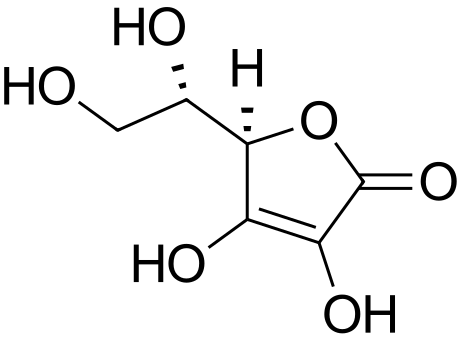
Ascorbic acid is a reducing agent converting copper(II) into a monovalent form that cataly…
General properties
| Appearance: | dark golden solid |
| Molecular weight: | 519.12 |
| CAS number: | 1032678-07-1 (chloride), 195867-59-5 (inner salt), 766503-38-2 (without anion) |
| Molecular formula: | C32H39ClN2O2 |
| IUPAC name: | 3H-Indolium, 2-[5-[1-(5-carboxypentyl)-1,3-dihydro-3,3-dimethyl-2H-indol-2-ylidene]-1,3-pentadien-1-yl]-1,3,3-trimethyl-, chloride |
| Solubility: | soluble in organic solvents (DMF, DMSO, dichloromethane), very poorly soluble in water (0.25 mM, 130 mg/L) |
| Quality control: | NMR 1H, HPLC-MS (95%) |
| Storage conditions: | Storage: 24 months after receival at -20°C in the dark. Transportation: at room temperature for up to 3 weeks. Avoid prolonged exposure to light. Desiccate. |
| MSDS: | Download |
| Product specifications |
Spectral properties
| Excitation/absorption maximum, nm: | 646 |
| ε, L⋅mol−1⋅cm−1: | 250000 |
| Emission maximum, nm: | 662 |
| Fluorescence quantum yield: | 0.2 |
| CF260: | 0.03 |
| CF280: | 0.04 |
Product citations
- Tsanaktsidou, E.; Margaroni, M.; Karagouni, E.; Kiparissides, C.; Kammona, O. In Vitro Assessment of a Doubly Adjuvanted Self-Emulsified Nanoemulsion as a Delivery Vehicle for Antigenic Proteins. Pharmaceutics, 2025, 17(7), 870. doi: 10.3390/pharmaceutics17070870
- Carreira, B.; Acúrcio, R. C.; Matos, A. I.; Moura, L. I. F.; Afonso, M. B.; Viana, A. S.; Santos, F. M. F.; Gois, P. M. P.; Rodrigues, C. M. P.; Guedes, R. C.; Satchi-Fainaro, R.; Florindo, H. F. Polymeric-Based Neoantigen Nanovaccine Synergizes with PD-1/PD-L1 Modulators, Reprogramming the Melanoma Microenvironment. Journal of Controlled Release, 2025, 387, 114178. doi: 10.1016/j.jconrel.2025.114178
- Tchatchiashvilli, T.; Duering, H.; Mueller-Boetticher, L.; Grune, C.; Fischer, D.; Pletz, M.W.; Makarewicz, O. PEG-PLGA nanoparticles deposited in Pseudomonas aeruginosa and Burkolderia cenocepacia. Journal of Pharmaceutical Analysis, 2024, 14(12), 100939. doi: 10.1016/j.jpha.2024.01.007
- Mamani, U.-F.; Ibrahim, M. N.; Liu, Y.; Fetse, J.; Lin, C.-Y.; Kandel, S.; Nakhjiri, M.; Koirala, S.; Guo, Y.; Alahmari, M.; Cheng, K. Exploring Multivalency in the Development of Anti-PD-L1 Peptides for Cancer Immunotherapy. Pharmaceutical Research, 2024, 41(12), 2275–2288. doi: 10.1007/s11095-024-03803-1
Cy® is a trademark of GE Healthcare.
This Product is offered and sold for research purposes only. It has not been tested for safety and efficacy in food, drug, medical device, cosmetic, commercial or any other use. Supply does not express or imply authorization to use for any other purpose, including, without limitation, in vitro diagnostic purposes, in the manufacture of food or pharmaceutical products, in medical devices or in cosmetic products.

Short link - lumiprobe.com/sh/p/T

The count of items is incorrect.

 Your cart is empty

 $
$