


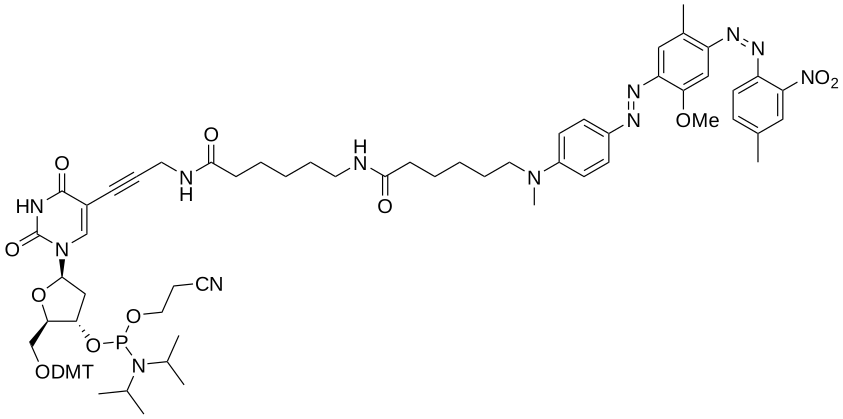
DusQ® 1 dT phosphoramidite
| Cat. # | Quantity | Price | Lead time | Buy this product |
|---|---|---|---|---|
| 1452-100mg | 100 mg |
$340.00
|
in stock | |
| 1452-500mg | 500 mg |
$1390.00

|
in stock | |
| 1452-1g | 1 g |
$2290.00
|
in stock |


DusQ 1 dT phosphoramidite is a modified oligo synthesis reagent bearing true dark quencher nucleotide base typically used to internally label DNA oligonucleotide probe. DusQ 1 efficiently quench fluorescence by FRET quenching and through static quenching via formation of a ground state complex with the reporter dye, and typically used to construct qPCR probes with a quencher moiety.
Reagent contains a DMT protection of the hydroxymethyl group, which allows oligonucleotide purification on cartridges. DusQ 1 can be paired with reporter dyes emitting in the green to yellow region to form completely non-fluorescent combination. DusQ 1 has a broad absorption spectrum with maximum in a range 480–580 nm and works in conjunction with the commonly used fluorophores, e.g. FAM, TET, JOE, HEX, and Cyanine3.
Usage
Coupling: 6 minutes coupling time recommended.
Deprotection: for 2 h at RT using ammonium hydroxide, or 10 min at 65 °C with AMA (solution of 30% ammonium hydroxide/40% aqueous methylamine 1:1 v/v).
Deprotection time depends on oligonucleotide composition and nucleobase protecting groups, and additional modifications.


Absorption spectrum of DusQ 1

Customers also purchased with this product


General properties
| Appearance: | black powder |
| Molecular weight: | 1411.58 |
| Molecular formula: | C76H91N12O13P |
| Quality control: | NMR 1H, 31P,HPLC-MS (95%) |
| Storage conditions: | Storage: 12 months after receival at -20°C in the dark. Transportation: at room temperature for up to 3 weeks. Avoid prolonged exposure to light. Desiccate. |
| MSDS: | Download |
| Product specifications |
Spectral properties
| Excitation/absorption maximum, nm: | 522 |
| ε, L⋅mol−1⋅cm−1: | 27300 |
Oligo synthesis details
| Coupling conditions: | 6 min coupling time |
| Cleavage conditions: | ammonia, 2 h at room temperature |
| Deprotection conditions: | identical to protected nucleobases |


 Your cart is empty

 $
$